
How to Stop Overthinking: A Dharmic Perspective
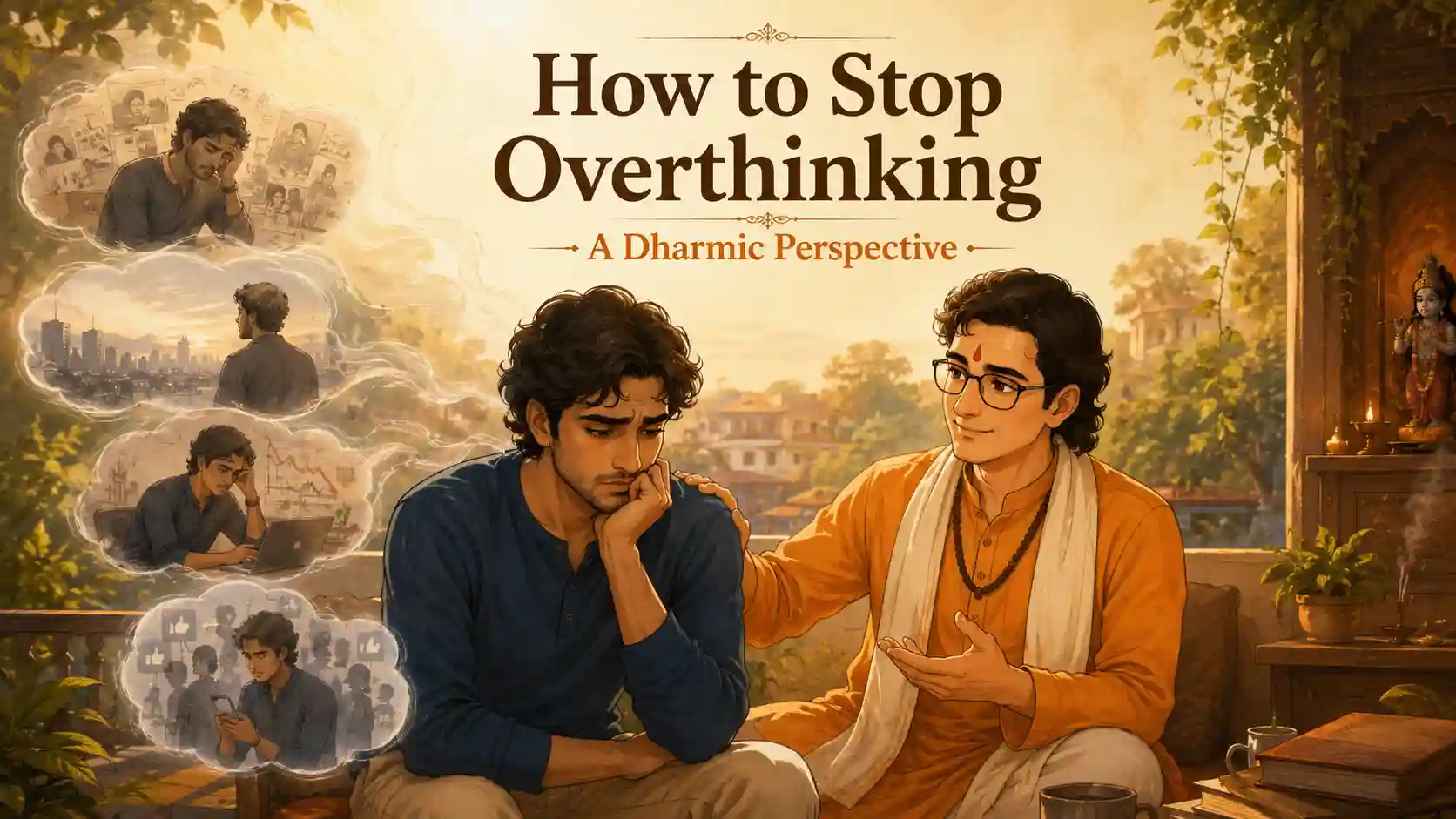
Have you ever had a thought that simply refuses to leave?
You replay a conversation in your head. You think about what might happen tomorrow. You imagine different outcomes.
Then you start wondering whether you should have done something differently.
And somehow, one small thought becomes an entire conversation inside your head.
That’s overthinking.
But have you ever looked at it from a Dharmic perspective?
Why Do We Overthink?
I think we humans have a strange habit.
We’re rarely completely satisfied with whatever is happening.
When things are going well, we still find a “but…”
“Everything is going well, but what if something goes wrong?”
And when things don’t go according to our plan, we immediately ask:
“Why?”
– Why did this happen?
– Why didn’t it happen the way I wanted?
– What will happen now?
And that’s when the mind starts travelling.
Sometimes it travels into the past, replaying decisions we’ve already made.
Sometimes it travels into the future, trying to predict things that haven’t happened yet.
But here’s something worth asking:
The decisions you made in the past will eventually show their results. Will worrying about them now change those results?
And the things that are going to happen will happen.
Will your overthinking change them?
I think this is where the real problem begins.
We start believing, “I can control it.”
And the moment we believe everything is under our control, we start worrying about the result.
And worry invites overthinking.
Thinking Isn’t the Problem. Getting Lost in Thought Is.
There is nothing wrong with thinking.
In fact, thinking is necessary.
You think when you’re brainstorming an idea. You think when you’re planning a task. You think when you’re preparing for something important.
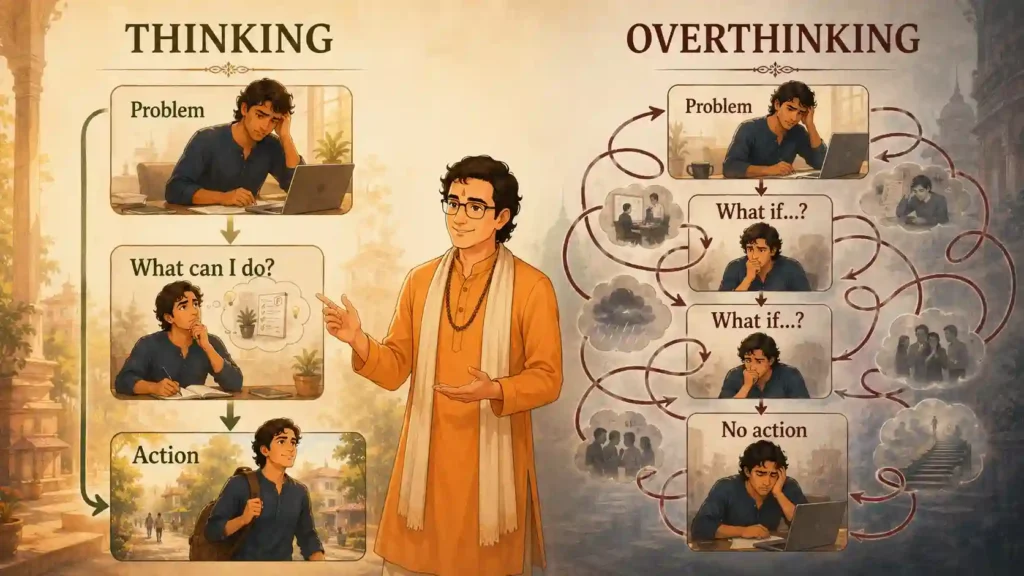
Thinking has a direction. You think about what needs to be done and how you can do it better.
Overthinking is different. You stop focusing on the process and start getting consumed by the result.
You don’t just think:
“How can I prepare for tomorrow’s meeting?”
You start thinking:
“What if they don’t like my idea?”
“What if I say something wrong?”
“What if the whole thing fails?”
Now you’re thinking about things that may not even happen and many of them aren’t in your control.
Thinking focuses on what can be done. Overthinking gets lost in what might happen.
3 Bhagavad Gita Lessons for an Overthinking Mind
The Bhagavad Gita has some beautiful lessons for a mind that keeps wandering between what has happened and what might happen.
And they are surprisingly practical for everyday life.
1. Bring the Mind Back to the Present
In Bhagavad Gita 6.26, Krishna tells Arjuna that whenever the restless mind wanders, it should be brought back again.
Notice something important here. Krishna doesn’t say that the mind will never wander. Because it will.
Your mind may be perfectly calm one moment and, the next, you are thinking about something that happened yesterday or worrying about something that hasn’t happened yet.
So the practice is simple:
Notice that you’ve wandered and bring yourself back.
Back to what is actually happening. Back to what you’re doing. Back to the present.
The mind may wander. Your job is to bring it back.
And sometimes, that is the practice.
2. Focus on Your Action, Not the Outcome
One of the most important teachings of the Bhagavad Gita comes in 2.47, where Krishna directs Arjuna toward action without attachment to its results.
Let me give you a simple example.
Suppose you’re arranging a birthday party. You’ve planned everything carefully.
You’ve contacted the guests, arranged the decorations, ordered the cake and booked the caterer.
The big day arrives. Everything is ready. And then you get a call.
The caterer is stuck in traffic.
Suddenly your mind starts racing.
“What if he gets too late?”
“What if people don’t get food?”
“What will happen now?”
But stop for a moment.
Is the traffic in your control? No.
So what is in your control?
You can keep yourself calm. You can look for another solution.
You can communicate with the guests. You can do whatever is possible in that moment.
But worrying about the caterer’s traffic won’t make him arrive any faster.
Your control is in your action, not in every outcome.
And once you’ve done what you can?
Leave the rest to Bhagwan.
3. Don’t Believe Every Thought Your Mind Produces
Here’s another important thing to understand.
A thought appearing in your mind doesn’t automatically make it true.
“What if I fail?”, that’s a thought.
“Everyone is judging me.” , that’s a thought.
“Something terrible will happen.” , that’s a thought.
You can notice a thought without allowing it to take over your entire mind.
The Gita’s teachings on the mind and the Self give us a useful way to look at this distinction.
You have a mind. You are not every thought your mind produces.
So when a frightening thought appears, you don’t have to immediately follow it.
You can notice it and then come back.
So, How Do You Stop Overthinking?
My friend, don’t start by telling yourself: “I have to stop overthinking.”
That can become another thing to worry about!
Instead, when you notice yourself overthinking, pause and ask:
“Have I done everything that I can do?”
If the answer is no, ask:
“What can I do right now?”
Then do it.
If the answer is yes, then ask:
“Is the rest in my hands?”
If it isn’t then leave it to Bhagwan.
That’s it.
Not because you don’t care but because you’ve understood the difference between your responsibility and what is beyond your control.

What Does “Bringing the Mind Back” Actually Mean?
It sounds simple but anyone who has tried to control their own mind knows how difficult it can be.
The mind wanders constantly.
You can be working on something and suddenly remember an old conversation.
You can be eating dinner and start worrying about tomorrow.
You can be trying to sleep and suddenly begin planning ten different possibilities.
So don’t get angry with yourself.
Notice it. Accept it. Bring it back.
And then, if it wanders again, bring it back again. And again.
You don’t need to become someone who never overthinks.
You need to become someone who recognises when the mind has wandered and knows how to return.
A habit built over years won’t disappear because you read one article. But you can begin training the mind.
A Small Practice From Sakha
The next time you find yourself overthinking, try this.
Close your eyes. Take a slow breath.
And ask yourself, “Have I done everything that I can do?”
If there is something you can still do, go and do it.
If you’ve already done your part, take another breath and tell yourself, “The rest is not in my hands.”
And leave it to Bhagwan.
Sometimes, peace doesn’t come from finding every possible answer.
It comes from knowing when you have done your part.
Sometimes, We Understand Better Through Stories
You know, my friend, some ideas become clearer when we see them being lived.
That is why I created Dharmic Sakha Ka Sidha Chashma, my first ebook, where everyday struggles like anger, worry, and expectations meet a practical Dharmic perspective through simple stories.
If you’d like to see what that feels like, step into Shanti Niketan for a while.
A Final Thought From Sakha
The next time your mind starts running ten steps ahead, don’t try to solve all ten.
Come back.
Ask yourself:
“What is mine to do right now?”
Do that sincerely and when there is nothing more in your hands, leave the rest to Bhagwan.
Because tomorrow doesn’t need to be solved today.
Sometimes, you find peace not by controlling more, but by knowing what was never yours to control.