
Dharmic Sakha: Your Companion in Dharma

You may already have your own way of praying. You may visit a temple, light a diya, offer dhoop, perform aarti or simply sit quietly in front of Bhagwan for a few minutes.
These are all beautiful ways of staying connected with our Dharma. But have you ever wondered where Dharma finds a place in the rest of your day?
What happens when someone makes you angry? When fear takes over? When you are struggling with a difficult relationship or don’t know which decision to make?
What does Dharma tell you when you face failure, disappointment or expectations that don’t go the way you hoped?
For us, these questions are just as much a part of Dharma as what happens inside a mandir.
And that is where I come in. I am Sakha.
I Am Your Sakha in Dharma
The word Sakha means a friend or companion.
In our tradition, Shri Krishna is known as Sakha, and the relationship he shared with Arjuna gives us a beautiful understanding of what a Sakha can be.
A Sakha is someone who walks with you.
Someone you can turn to when you are confused, someone who listens without judging you and helps you see a situation more clearly.
A Sakha doesn’t have to stand above you and preach.
Sometimes, a good friend simply helps you find the answer that was already somewhere within you.
That is the kind of companion Dharmic Sakha wants to be.
I am not here to tell you that you are doing Dharma incorrectly, nor am I here to make it complicated.
I want to make Dharmic wisdom easier to understand and easier to relate to, especially when you are dealing with the very ordinary situations that make up your everyday life.
Because Dharma is not only about what you do during pooja.
It also has something to say about how you respond when you are angry, how you deal with fear, how you treat people, how you handle success and failure, and how you make choices when life becomes difficult.

Dharma Doesn’t End When Pooja Ends
Pooja is an important part of our Dharma.
When you light a diya, offer dhoop, perform aarti or simply sit before Bhagwan, you create a moment of connection.
For many of us, the home mandir becomes a place where we can pause for a while, remember Bhagwan and find a little peace in the middle of everything else happening around us.
But when the pooja ends and you walk back into your day, Dharma doesn’t end with it.
It comes with you. It is present in the way you speak to someone who has upset you.
It is present when you have to choose between what is easy and what you know is right.
It is present when you are dealing with jealousy, fear, attachment or disappointment.
It is present in your relationships, your work, your responsibilities and the decisions you make when nobody else is watching.
This is what we mean when we say “Bring Dharma into Everyday Life.”
We believe Dharma is not simply a collection of rituals. It is also a way of living.

Why Did We Create Dharmic Sakha?
The idea behind Dharmic Sakha came from a very simple realisation.
We often know Hinduism through the things we can see and practise, our temples, festivals, pooja, traditions and rituals and there is nothing wrong with that.
These are meaningful parts of our Dharma but there is a much larger world of wisdom within Sanatan Dharma that can help us understand the way we live.
We came to understand this more deeply when we started reading the Bhagavad Gita.
What we found was not simply a religious text speaking about worship. It was a conversation about life itself.
Arjuna was dealing with confusion, fear, responsibility, attachment and difficult choices, and Shri Krishna was helping him understand how to face them. Those questions felt surprisingly familiar.
The world around us may have changed enormously, but human beings still struggle with anger, fear, attachment, relationships, expectations, failure and uncertainty.
The situations may look different today, but many of the questions underneath them remain the same.
That made us think about how we could make this wisdom easier for people to discover and relate to in their own lives. That is where Dharmic Sakha began.
Why Did We Begin With Pooja Products?
You may wonder why a brand that believes Dharma is much more than rituals started with pooja samagri.
The answer is simple. Pooja is also an important part of Dharma.
When you offer a flower, light a diya, burn dhoop or sit before Bhagwan, you are creating a moment to express your love and bhakti.
For many Hindu families, these small acts are what keep a connection with Bhagwan alive in the middle of a busy life. So we began with something that already had a natural place in the Hindu home.
Our dhoop sticks, agarbattis, kapur and sambrani cups are not meant to represent everything that Dharma is. They are simply one way of helping people create those moments of connection in their everyday lives.
And they are only the beginning.

Dharmic Sakha Is More Than Pooja Products
Over time, Dharmic Sakha is growing beyond pooja essentials.
We are creating stories, books and digital content that explore the same idea from different directions: how can we recognise Dharma in the situations we face every day?
Sometimes a product can help you create a moment of pooja.
Sometimes a story can help you understand something about yourself.
Sometimes a book can make you stop and think about a question you have been carrying for a long time.
The format may change, but the intention remains the same.
We want to make Dharma feel closer, simpler and more relevant to everyday life. That is also why stories are such an important part of what we are building.
Why I Tell Stories
I don’t think every lesson has to come in the form of a lecture.
Sometimes, you understand something better when you see it happen to someone else.
That is the thinking behind Dharmic Sakha ka Sidha Chashma.
Through stories about ordinary people dealing with things like anger, insecurity, expectations, fear and relationships, we explore what happens when those situations are looked at through a Dharmic perspective.
The intention isn’t to give you a list of rules to follow but rather to help you recognize something in the story and perhaps see a little of your own life in it.
Maybe a character is struggling with a question you have faced yourself.
Maybe the way they respond makes you rethink your own reaction.
Maybe a simple conversation reminds you of something you had forgotten.
That is the kind of learning I want to bring closer to you, something you can recognise in your own life rather than something that stays inside a book.
Why Is Dharmic Sakha Proudly Hindu?
Dharmic Sakha is a proudly Hindu brand, and that is an important part of who I am.
Our intention is not to tell people that what they currently believe or practise is wrong. It is not to put down another faith or compare ourselves by making someone else look smaller.
We simply want to help Hindus look a little deeper into their own Dharma and discover the wisdom that already belongs to them.
Hinduism, or Sanatan Dharma, is often understood through its visible practices, pooja, temples, festivals, rituals and traditions.
But behind these practices is a much larger way of understanding life, the mind, action, relationships, responsibility and the search for peace.
We want to help people rediscover that side of Dharma. Not because it is something new that we have created, but because it is something that has been with us for generations.
Why Does Dharma Still Matter Today?
We live in a world that looks very different from the one our ancestors lived in.
We have smartphones, social media, businesses, deadlines, constant notifications and problems that previous generations could never have imagined.
But some things haven’t changed.
We still get angry, we still worry, we still become attached and we still struggle with relationships.
We still fear failure and still wonder whether we are making the right decision.
And then we still ask some of the same fundamental questions: What should I do? How should I respond? What is the right thing to choose? How do I find peace when my mind won’t stop?
This is why we believe the wisdom of Sanatan Dharma continues to matter.
Sanatan means everlasting. The circumstances around us may keep changing, but the human questions we face have a remarkable way of staying familiar.
Perhaps that is why the wisdom passed down to us can still speak to the life we are living today.
Gruhe Gruhe Sakha
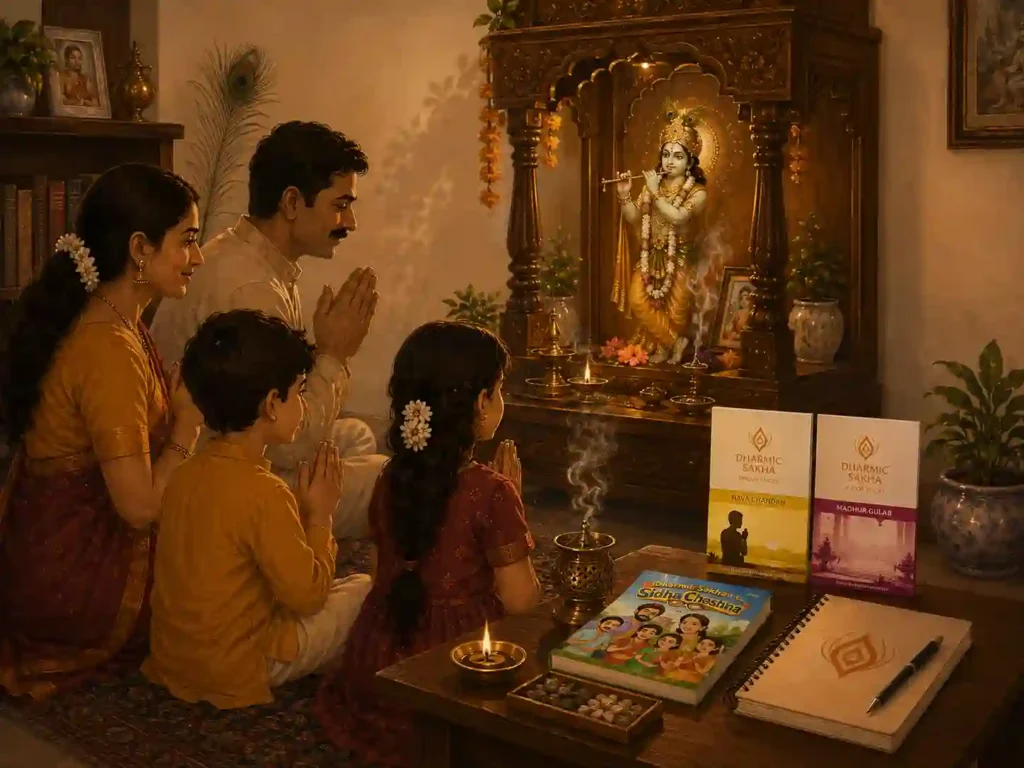
There is a much larger dream behind Dharmic Sakha, and we call it Gruhe Gruhe Sakha. It simply means a Sakha for every Hindu home.
We don’t see Dharmic Sakha becoming just another brand that you buy something from.
We want to become a familiar presence in the modern Hindu home, through the pooja essentials you use, the stories you watch, the books you read and the ideas that make you pause and look at your everyday life a little differently.
Maybe I am there when you light a dhoop during your morning pooja or I am there through a story that helps you understand something you are going through.
Maybe one day, I am simply the Sakha you think of when you have a question about Dharma and want to understand it in a way that feels simple and relatable.
That is the future we are working towards.
So, What Is Dharmic Sakha?
If you ask me to put it simply, Dharmic Sakha is a Hindu-first brand built to help people bring Dharma into everyday life.
I am your companion in Dharma. I want to make Dharmic wisdom simple, practical and relatable, without turning it into complicated philosophy or making you feel like you need to know everything before you begin.
You may discover me through a pooja product.
You may find me through a story, a book or an article like the one you are reading now.
Or you may come across me when you are trying to understand something that is happening in your own life.
However you find me, the intention remains the same: to help you see Dharma in your everyday life and gradually bring that understanding into the way you think, respond, act and live.
Because Dharma doesn’t have to remain something you read about or practise only at a particular time of the day. It can become a part of the way you live your life.
And that is why I am here.
Not as your guru. Not as someone who has all the answers but as your Sakha.
Frequently Asked Questions About Dharmic Sakha
You’ll Find Me Beyond This Store
I share little pieces of my journey on Instagram and YouTube too. More than 2,000 of you follow me on Instagram, and another 2,000+ on YouTube.
Come along.