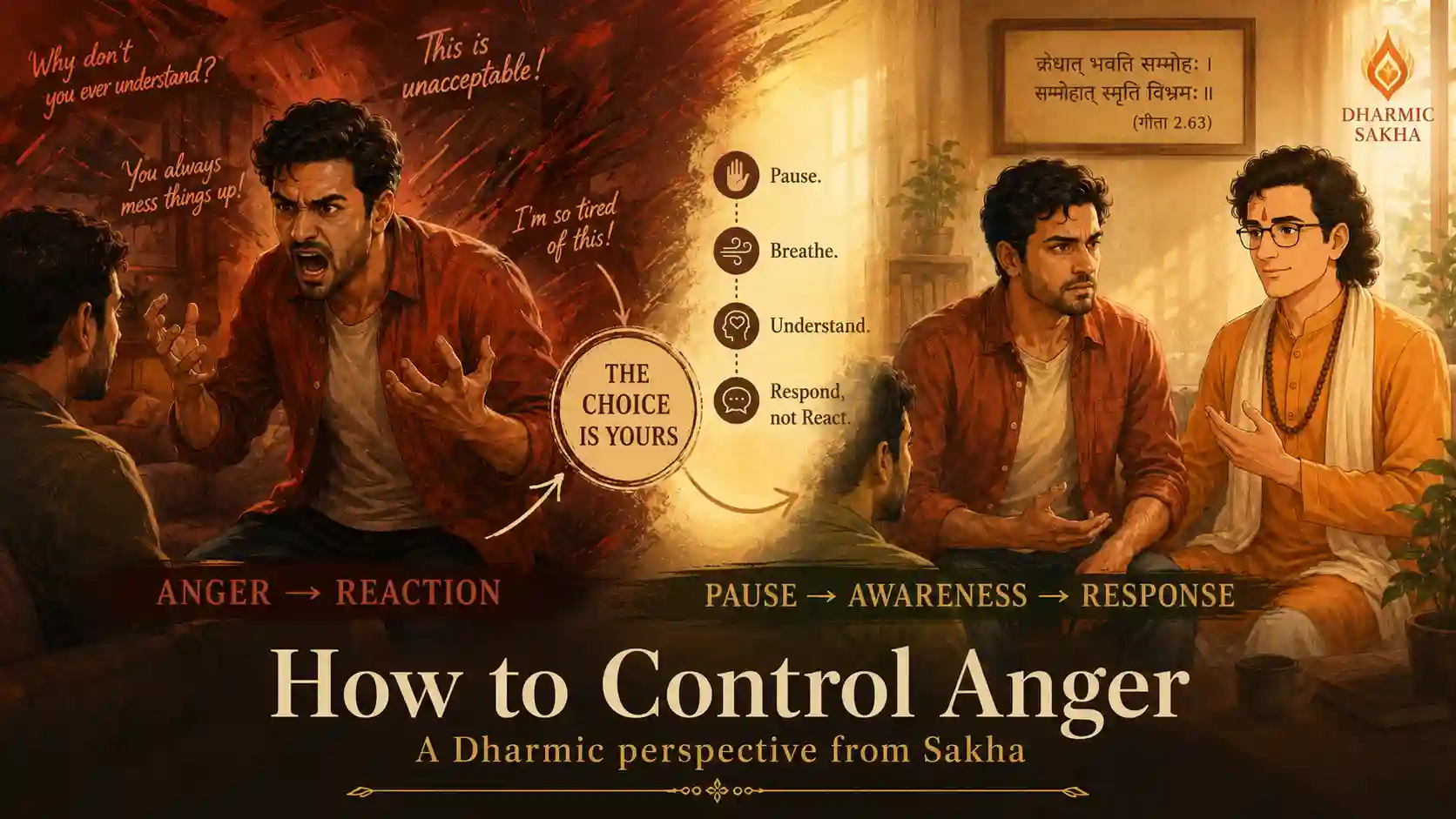
How to Control Anger: A Dharmic Perspective from Sakha
Have you ever been angry over something that seemed very small afterward?
Someone didn’t do something the way you expected. Someone said something you didn’t like.
Someone made a mistake.
Someone interrupted you.
And suddenly, your voice became louder than you intended. Your words became sharper.
For a few moments, it felt as though the anger was stronger than you. Then the anger passed.
And perhaps you were left thinking:
“Why did I react like that?”
Maybe you even regretted what you said.
But when the same kind of situation happens again, the same thing happens again.
You get angry, you react, you calm down and then you regret it.
And somewhere inside, you wonder:
“How do I control my anger?”
Have you ever looked at anger from a Dharmic perspective?
Because the Bhagavad Gita doesn’t simply tell us that anger is something we should control.
It helps us understand where anger begins.
Hello, I’m Sakha, come, sit with me for a moment.
Let’s look at this together.
Why Does Anger Take Over So Quickly?
Let’s think about an ordinary day.
You wake up late. Something at home doesn’t go the way you wanted. You reach work and someone has made a mistake. A meeting takes longer than expected. Traffic is terrible. Someone cuts in front of you. You finally reach home, tired.
Then someone says something completely harmless.
And suddenly, you explode.
Later, you may wonder:
“Why did that one thing make me so angry?”
But perhaps that one thing wasn’t the whole reason.
Perhaps you were already carrying everything that came before it.
One irritation. Then another. Then another.
Each one quietly adding to the next.
Sometimes, the last thing that happens isn’t the real reason we lose our temper.
It is simply the thing that finally breaks our patience.
This is why controlling anger begins much earlier than the moment when we shout.
We have to learn to notice what is happening inside us before the anger reaches its peak.
Because anger rarely walks into the room announcing:
“Hello, I have arrived.”
It often begins quietly. A little irritation. A little disappointment. A thought that keeps repeating. A feeling that things shouldn’t be this way.
And before we know it, that small irritation has become anger.
Anger Often Begins With a “Should”
Let me ask you something.
How many angry thoughts begin with the word “should”?
They should have listened to me. He should have understood. She shouldn’t have spoken to me like that. They should have done their work properly. Things should have gone my way. Someone should have respected me.
Do you see what is happening?
We have an idea in our mind about how something is supposed to happen. And when reality refuses to follow that script, we become frustrated. Sometimes, that frustration becomes anger.
This doesn’t mean that every expectation is wrong.
Of course we can expect basic respect. We can expect responsibility. We can expect people to keep their word. We can expect ourselves to do our duties sincerely.
The question is not whether we should have expectations.
The question is:
How tightly are we attached to them?
Because the stronger our attachment to a particular outcome, the harder it can be when reality gives us something else.
You expected someone to understand you.
They didn’t.
You expected someone to appreciate your effort.
They didn’t.
You expected something to happen today.
It didn’t.
And suddenly the mind says:
“This shouldn’t be happening.”
That frustration can become the fuel for anger.
So the next time you feel anger rising, try asking yourself:
“What did I expect to happen?”
You may be surprised by the answer.
Sometimes, behind the anger is not hatred. Sometimes, there is simply a frustrated expectation.
A Bhagavad Gita lesson about anger
The Bhagavad Gita doesn’t simply ask us to suppress anger. It helps us look deeper and understand what happens inside us before anger takes over.
Because anger rarely appears out of nowhere. Something we wanted didn’t happen. Someone didn’t behave the way we expected. Something disturbed an attachment we were holding onto.
And perhaps that is where the lesson begins: when we understand where anger is coming from, we have a better chance of noticing it before it begins controlling us.
What does the Bhagavad Gita say about anger?
This is where Krishna’s wisdom becomes especially interesting.
In the Bhagavad Gita, Krishna describes a progression that begins with where we place our attention.
When the mind repeatedly dwells on something, attachment can develop. From attachment comes desire and when that desire is frustrated, anger can arise.
Krishna describes this progression in Chapter 2, Verses 62 and 63.
In simple terms:
Dwelling → Attachment → Desire → Frustration → Anger → Loss of clarity
Think about how this can happen in everyday life.
Someone says something hurtful. You keep thinking about it.
“How could they say that?”
You replay the conversation. You imagine how they should have spoken to you. You become attached to the idea that they must treat you differently. But they don’t. The frustration grows. And eventually, anger appears.
Now something interesting happens.
The original situation may have been small but your mind has spent hours feeding it. And by the time anger arrives, you’re no longer responding only to what happened.
You’re responding to everything your mind has built around what happened.
Sometimes, the anger doesn’t end when the situation ends.
The mind keeps replaying the conversation, imagining what we should have said or what might happen next. That is often where anger and overthinking begin feeding each other.
This is why Krishna’s teaching goes beyond simply saying:
“Don’t be angry.”
He shows us how anger can begin and if we understand where it begins, perhaps we can notice it earlier.
Anger Doesn’t Just Change What We Say. It Can Change What We See.
Have you noticed how differently you see things when you’re angry?
When you’re calm, someone might say:
“I was only joking.”
And you might laugh.
But when you’re already angry, the exact same words can feel like an insult.
When you’re calm, a friend’s mistake might seem like an ordinary mistake.
When you’re angry, it can suddenly feel like:
“They don’t care.”
When you’re calm, someone asking you a question might be harmless.
When you’re irritated, it can feel like:
“Why is everyone bothering me?”
The situation may not have changed.
Your state of mind has.
And this is one of the most important things to understand about anger.
Anger doesn’t simply make us speak loudly. It can affect the way we interpret what is happening around us.
Krishna goes on to explain that anger can lead to delusion, and from there to the loss of discrimination, our ability to see clearly and make wise choices.
Think about the things people sometimes say in anger:
“I didn’t mean that.”
“I don’t know why I said it.”
“I wasn’t thinking.”
Perhaps that’s exactly the problem.
For those few moments, we weren’t thinking clearly.
And once the anger disappears, clarity returns. But the words may already have been spoken. The message may already have been sent. The relationship may already have been hurt.
That is why learning to control anger matters. Not because anger makes you a bad person. But because anger can make a good person behave in ways they themselves don’t want.
Anger Doesn’t Make You a Bad Person
Let me tell you something important.
Getting angry doesn’t automatically make you a bad person.
You can be loving and still lose your temper. You can be kind and still say something harsh. You can care deeply about someone and still hurt them when you’re angry. And you can regret your reaction afterward.
The question isn’t:
“Am I a bad person because I get angry?”
The better question is:
“What am I allowing my anger to make me do?”
There is a difference between feeling anger and acting from anger.
The feeling may arise before you can stop it but there can still be a moment before the action. And that moment matters. Because in that moment, you have a choice.
You can let anger speak Or you can wait for your wisdom to return.
So, How Do You Actually Control Anger?
Now you might say:
“Sakha, this all sounds good. But what do I actually do when I’m angry?”
Fair question. First, don’t expect yourself to become someone who never feels anger.
That’s not realistic.
Instead, learn to recognize it earlier.
1. Notice the first signs
Don’t wait until you’re shouting. Notice the irritation before it becomes an explosion.
Maybe your body becomes tense. Maybe your thoughts become faster. Maybe you suddenly feel the urge to respond immediately. Maybe your voice starts changing.
That is your signal.
“Something is happening inside me.”
Notice it
2. Ask what is underneath the anger
Instead of asking only:
“Why am I so angry?”
ask:
“What did I want to happen?”
Maybe you wanted respect. Maybe you wanted someone to understand you. Maybe you wanted things done properly. Maybe you wanted control. Maybe you wanted someone to behave differently.
Finding the expectation underneath your anger can help you understand what is really happening.
3. Pause before you respond
This is perhaps the simplest and most powerful step.
Don’t immediately speak. Don’t immediately send the message. Don’t immediately make the decision.
Take a breath. Walk away for a moment if you need to.
You aren’t running away from the problem.
You’re creating enough space to respond to it without anger deciding everything for you.
4. Let your clarity return
Remember what Krishna teaches us about the effect of anger on our ability to think clearly.
So give yourself a moment.
Ask:
“If I respond right now, will I be proud of what I say tomorrow?”
Sometimes, that one question is enough.
5. Then choose your response
Once the intensity has reduced, you can still address the problem.
You can say:
“What you did wasn’t okay.”
You can disagree. You can correct someone.
You can set a boundary. You can say no. You can walk away.
Controlling anger doesn’t mean becoming silent or allowing people to treat you badly.
It means:
You decide how to respond. Anger doesn’t decide for you.
Sometimes, We Understand Better Through Stories
You know, my friend, some ideas become clearer when we see them being lived.
That is why I created Dharmic Sakha Ka Sidha Chashma, my first ebook, where everyday struggles like anger, worry, and expectations meet a practical Dharmic perspective through simple stories.
If you’d like to see what that feels like, step into Shanti Niketan for a while.
What If Someone Has Actually Wronged Me?
This is an important question. Because sometimes, someone really has hurt you.
Someone may have lied to you. Disrespected you. Taken advantage of you. Broken your trust. So should you simply take a deep breath and pretend everything is fine?
No. Dharma does not ask you to become passive.
There is a difference between responding firmly and reacting blindly.
You can be angry and still choose your words carefully. You can be hurt and still protect your boundaries.
You can tell someone that their behaviour was wrong without trying to hurt them back.
You can walk away without creating another wound.
In fact, sometimes the strongest response is the one made after the anger has settled.
Because then you are responding from clarity rather than simply trying to release the emotion.
Ask yourself:
“What needs to be done here?”
Not:
“What can I say that will hurt them as much as they hurt me?”
That small difference can change everything.
You Don’t Have to Stop Anger. You Have to Stop Letting It Decide.
Krishna gives another important teaching in Bhagavad Gita 5.23.
He speaks of the person who can withstand the force of desire and anger before they overwhelm him.
Think about that.
The teaching isn’t asking you to become a person who never experiences these emotions. It is asking you to develop the strength to not be ruled by them.
Maybe anger will still rise.
Maybe your heart will still beat faster.
Maybe you will still feel that urge to say something.
But you can learn to create a little space between:
what you feel
and
what you do.
And sometimes, that little space is where your freedom lives.
One breath. One pause. One moment of silence.
Enough time for wisdom to return.
When Anger Speaks Before You Do
You know, my friend, while talking about anger, I am reminded of someone from Shanti Niketan Society.
His name is Gussalal. He is a good man, but anger has a habit of reaching his tongue before his wisdom does.
One difficult day, after one irritation followed another, Gussalal found himself reacting in a way he immediately regretted.
Later that evening, he came and sat beside me.
He had just one question:
“Why can’t I control my anger, Sakha?”
What followed was a conversation about anger, expectations, and the moment when we have to choose whether anger speaks for us, or wisdom does.
It became one of the first stories I shared in Dharmic Sakha Ka Sidha Chashma.
Perhaps, when you meet Gussalal, you’ll understand a little more about your own anger too.
Meet Gussalal in Dharmic Sakha Ka Sidha Chashma →

A Word From Sakha
So, my friend, the next time you feel anger rising, don’t immediately ask:
“How do I get rid of this anger?”
Pause. Look a little deeper.
Ask:
“What was I expecting?”
“What am I feeling right now?”
And then:
“What do I want to choose?”
You may not always be able to stop anger from arriving. But you can learn to stop it from deciding what happens next.
Because anger may speak loudly. But it doesn’t have to speak for you.
Don’t let anger decide how you respond.
Sometimes, all you need is one small moment between the anger you feel and the action you take.
In that moment, your wisdom can return.
And sometimes, that one moment can change everything.
Explore More Everyday Dharma
Our struggles may look different, but many of them begin in the same place, the way our mind reacts to what happens around us.
If this conversation about anger made you think about another struggle you carry, Sakha has something else you may want to explore.