
Why Do I Compare Myself to Others? A Dharmic Perspective
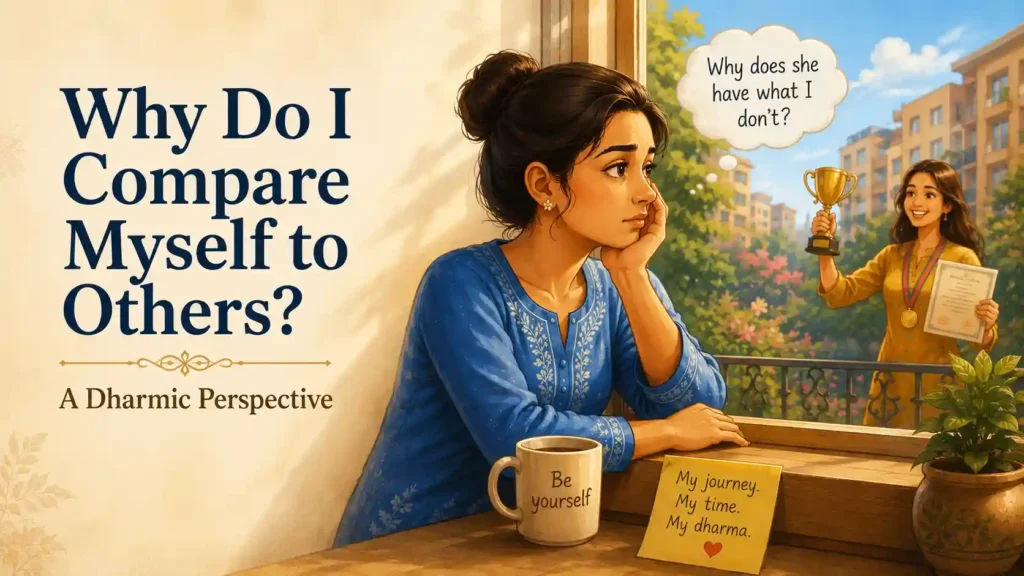
Have you ever looked at someone else and suddenly felt that something was missing in your own life?
Maybe they look more beautiful than you.
Maybe someone your age is already more successful.
Maybe a friend seems happier, more confident, or more settled.
And then a small thought enters your mind: “Why am I not like that?”
If you’ve ever wondered why you compare yourself to others, you’re not alone.
But have you ever looked at comparison from a Dharmic perspective? Because the Bhagavad Gita has an answer to this too.
I’m Sakha. Think of me as a friend who sits beside you when life’s questions become a little difficult.
I won’t give you a lecture. Come, let’s look at this together.
Why Do We Compare Ourselves to Others?
Let me ask you something.
When you see someone doing well in life, what is the first thought that comes to your mind?
“Good for them.”
Or:
“Why am I not there yet?”
When you see someone who looks beautiful, perhaps you first notice their beauty.
But then the mind quietly adds one little word:
“She looks better than me.”
That little word, “than” can change everything.
There is nothing wrong with admiring someone’s success.
There is nothing wrong with appreciating someone’s beauty.
There is nothing wrong with seeing a quality in someone and thinking:
“I wish I could develop that too.”
The trouble begins when observation becomes comparison, and comparison becomes self-judgment.
You see someone successful and decide that because they are ahead, you must be behind.
You see someone confident and suddenly notice everything you dislike about yourself.
You see someone happy and wonder why your own life doesn’t look like theirs.
The mind moves from:
“They have something I admire.”
to:
“I don’t have what they have.”
And finally:
“Maybe I’m not good enough.”
That is when comparison starts hurting.
What Does the Bhagavad Gita Say About Comparison?
Now, my friend, this is where the conversation becomes interesting.
You may not find Krishna simply saying, “Don’t compare yourself with others.”
Instead, the Gita gives us something deeper through the idea of svadharma, your own dharma, your own path.
In Bhagavad Gita 3.35, Krishna reminds Arjuna that it is better to follow one’s own dharma imperfectly than to follow another’s perfectly.
Why is that so important? Because your life is not supposed to be a copy of someone else’s.
Imagine two people who both choose work they genuinely love.
One finds the right opportunities early, grows quickly, and begins seeing visible success.
The other is equally passionate, but their path comes with different challenges. Progress is slower, and the results take longer to show.
Looking at the first person, they may wonder:
“Why am I not growing like them?”
But they forget that they aren’t walking the same path.
One person’s faster growth doesn’t mean the other’s journey is going wrong.
That is the essence of Krishna’s teaching on Svadharma: your path may look different, and your pace may be different but it is still yours to walk.
Your Journey Is Yours
Someone else’s success doesn’t make you a failure. Someone else’s beauty doesn’t make you less worthy.
Their path is simply not yours.
Of course, you can admire others. You can learn from their qualities and let their journey inspire your own.
But there is a difference between:
“I want to learn from them.”
and:
“I wish I were them.”
One helps you grow. The other makes you forget your own path.
So instead of asking:
“Why am I not like them?”
ask:
“What is mine to cultivate?”
What Can I Do When I Catch Myself Comparing?
You may be thinking:
“Sakha, this sounds good. But what do I actually do when comparison happens?”
Fair question.
Don’t expect yourself to never compare again. You’re human.
The mind notices. The mind measures. The mind reacts.
What matters is what you do after you notice it.
The next time you catch yourself comparing, pause and ask:
What exactly am I comparing?
Their appearance? Their money? Their career?
Their relationship? Their success? Their confidence?
Be specific.
Then ask: What am I telling myself because of it?
Are you thinking: “I’m not good enough.”
“I’ll never have that.”
“Something is wrong with me.”
Sometimes, the painful part isn’t what the other person has.
It’s the story you’ve started telling yourself about what their qualities mean about you.
Then ask:
“Do I genuinely admire something or have I simply decided that I am less because I don’t have it?”
If you genuinely admire something, perhaps there is something you can learn.
If you’re simply feeling inferior, perhaps it’s time to return to your own path.
And ask: “What is mine to cultivate?“
Maybe you want to become healthier. Cultivate it.
Maybe you want to become kinder. Cultivate it.
Maybe you want to become more disciplined. Cultivate it.
Maybe you want to improve your work. Work on it.
Don’t spend all your energy trying to become someone else. Use it to become more fully yourself.
You Know, I’ve Met Someone Who Struggled With This Too
You know, my friend, while talking about comparison, I am reminded of someone I met in Shanti Niketan Society.
Her name was Komal Devi. Komal had spent years believing that beauty meant having fair skin and attractive features.
So whenever she saw someone she considered more beautiful, she didn’t simply admire them. She looked at herself.
And judged herself.
One day, after an insensitive comment about her appearance, that insecurity became heavier than usual.
That night, she found herself asking Bhagwan a question that had been sitting inside her for years:
“Why didn’t you make me beautiful like others?”
Her question wasn’t really about another woman. It was about her own worth.
“Why am I not enough?”
That evening our conversation slowly took us somewhere deeper than beauty.
It made her question the way she had been looking at herself all these years.
I wanted to share stories like Komal’s because sometimes an idea becomes easier to understand when we see someone living through it.
Those conversations became part of Dharmic Sakha Ka Sidha Chashma – The Story of ShantiNiketan, my first Ebook.
If you’d like to meet Komal and the other people of Shanti Niketan, you can step into their stories.

Perhaps You Don’t Need to Become Someone Else
Maybe comparison will still appear.
You may still see someone and think: “I wish I had what they have.”
That’s okay. Pause there.
Don’t turn that thought into a judgment about yourself.
Someone else’s life can be beautiful without making yours inadequate.
And when the mind asks: “Why am I not like them?”
perhaps you can gently ask: “What is mine to become?”
One question takes you away from yourself.
The other brings you back.
And perhaps that is where Dharma quietly begins, not when you become better than someone else, but when you sincerely begin walking your own path.
A Word From Sakha
So, my friend, the next time you catch yourself comparing your life with someone else’s, don’t be too harsh on yourself.
Take a breath. Look again.
You may discover that the person you were comparing yourself with was never really your competition.
You were simply looking at their journey while forgetting your own.
Your worth was never meant to be calculated by someone else’s life.
Walk your path. Cultivate what is yours.
Let others walk theirs.
And if you ever find yourself asking: “Why am I not like them?”
remember: Your path is yours. Walk it sincerely.
Sometimes, We Understand Better Through Stories
You know, my friend, some ideas become clearer when we see them being lived.
That is why I created Dharmic Sakha Ka Sidha Chashma, my first ebook, where everyday struggles like anger, worry, and expectations meet a practical Dharmic perspective through simple stories.
If you’d like to see what that feels like, step into Shanti Niketan for a while.